Human+ builds the human skills that drive performance by letting people rehearse the conversations that matter most. Your people practise a sales call, a price negotiation or a piece of hard feedback with a realistic AI human who pushes back or opens up, depending on how the conversation goes. Skills are what people achieve. The Human+ approach is how we help them get there.
Now we've built Hume's expression AI into Human+. The AI humans now react to a learner's tone of voice as well as their words.
For a learner, the practice partner now behaves much more like the person they'll face in the real conversation.
Why scoring the transcript isn't enough for practice
Most practice tools score the transcript. They count pace, filler words and interruptions, and those counts are useful. But in a real conversation the other person reacts to tone, energy and a look as much as to the words.
A partner that only gets the words can't react the way a person would. It treats the right sentence the same whether it's said with conviction or in a flat, hurried voice. The learner ends up rehearsing an easier conversation than the one waiting for them at work.
Introducing Hume's Expression Measurement
Hume builds AI that understands human expression in the voice. Its models draw on more than 10 years of emotion science research, more than 100 million speech samples and more than 50 languages. That depth is why we chose Hume, and this launch builds on our partnership with Hume.
In Human+ we use Hume's Expression Measurement in order to understand how a learner sounds. With it we can process vocal expressions, such as interest, doubt or calm, and qualities of the voice, such as monotone or clear.
Every score is the chance that human listeners would perceive that expression. It describes how the learner comes across, never what they feel inside. So a high score for doubt means a listener would likely hear doubt in that sentence, which is what the person across the table would react to.
How Human+ turns that reading into a character that reacts
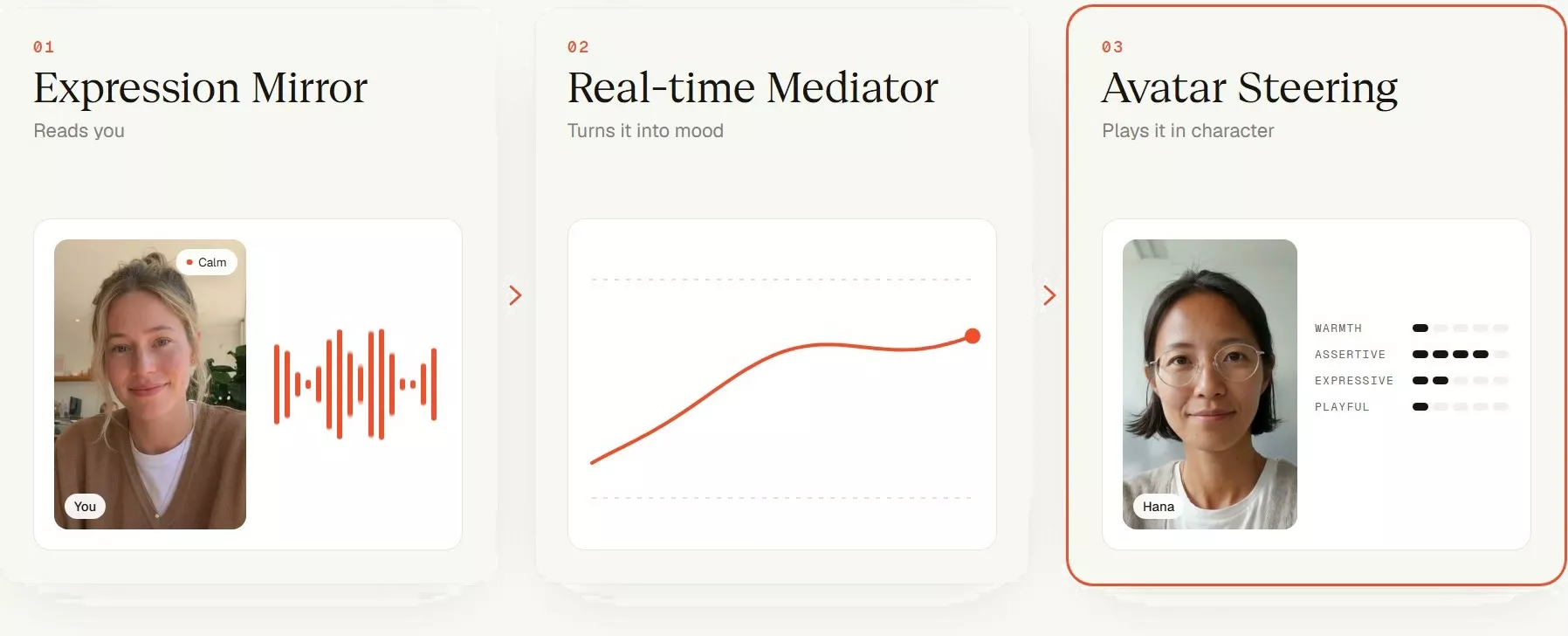
Three parts of Human+ do this work, one after the other.
Expression Mirror
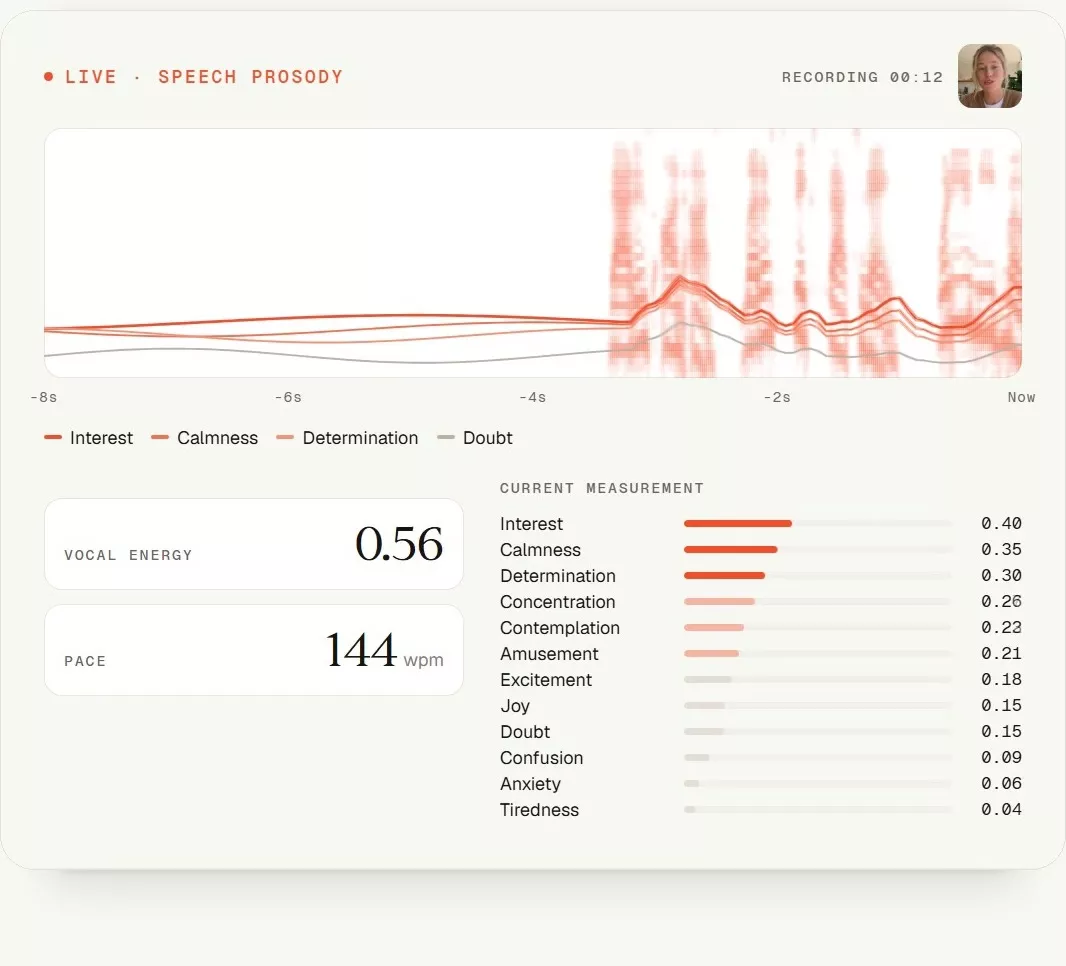
Expression Mirror collects three channels for each turn of the learner's:
- The voice, read by Hume.
- The face, read by face tracking that runs in the learner's own browser. It picks up eye contact, a smile or a frown.
- Pace, from the timing of the words.
Hume reads only the voice. By the end of each turn, Human+ knows what the learner said, how it sounded, how they looked while saying it and how fast they spoke.
Real-time Mediator
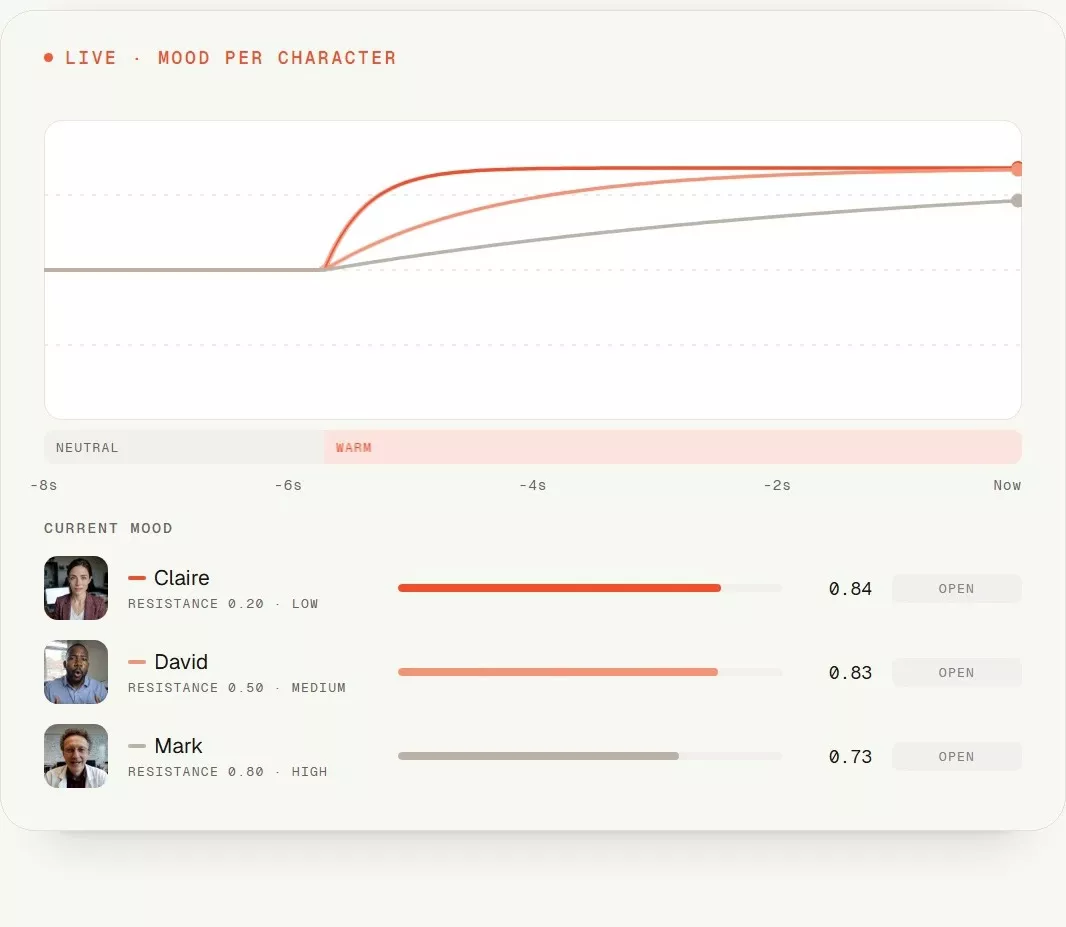
Real-time Mediator combines those channels into the character's mood, on a five-step scale from lowest to highest.
The words come first. A character's mood only rises when the learner says something that earns it, such as a real answer to its objection. Tone of voice and expression then decide how far it rises. The same good answer moves the character further when it's said warmly than when it's said flatly.
Each character also has its own resistance, which decides how far one good moment moves it. A low-resistance character warms up quickly. A high-resistance one needs several good turns in a row, so the answer that wins over an easy-going character barely moves a sceptical one, and the learner has to keep earning it.
Avatar Steering
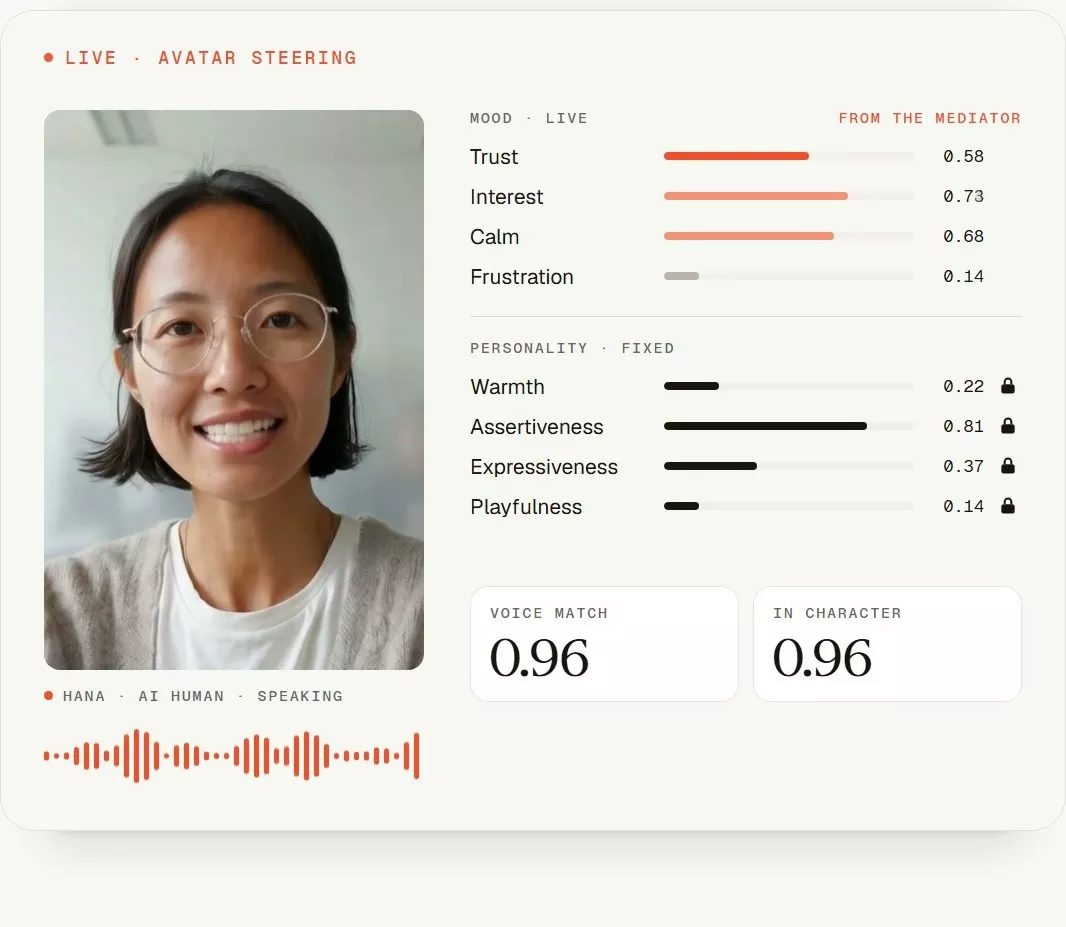
Avatar Steering passes that mood into every reply the character gives. It shapes what the character says and how its voice sounds.
The character's four personality traits are warmth, assertiveness, expressiveness and playfulness, and they're fixed for the whole conversation. So a reserved, assertive buyer who starts to trust the learner answers more openly and asks a real follow-up question. They still speak briefly and firmly, the way that person would.
What learners get, and what teams see
After each session, the learner gets a report that only they can open. It shows how the character's mood moved during the conversation, how they came across, and the moments where a skill was shown or missed. They can ask a coach about any of it, then go straight back in and try again.
Teams see skills grow, while each person's results stay private.
Built to comply, wherever you work
As a European company, we're bound by the EU AI Act, and we build Human+ to comply with it. Requirements for voice and expression AI differ around the world and keep changing, so Human+ adapts to wherever it's used.
Your organisation stays in control of how it's set up for your teams. We're happy to walk you through the details in a demo.
Why real practice matters to us
Human skills are what decide performance, and people only build them by practising for real. That's why we put this much work into a practice partner that reacts like a person, and into a report that belongs to the learner alone.
Teams see skills grow, while every session stays private, for you to improve. How you get there is yours alone. See how you come across, how you steer the conversation, and level up for yourself.
Real performance needs real practice. Rehearse the conversations that matter most, with the most realistic AI humans.
This is the Human+ approach.